
For a Savannah insurance agency, an AI receptionist beats a traditional answering service on the two things that decide a quote — how fast the caller is helped and whether the person who helps them actually understands insurance — and it does it without a per-minute meter or a payroll line. A live answering service takes a message; voicemail takes nothing. An AI receptionist answers on the first ring, qualifies the caller by line of business, captures TCPA consent, books the quote appointment, and logs the whole thing into your GoHighLevel pipeline — 24/7, and without buckling when a coastal storm triples your call volume overnight.
This is the operator comparison: how an AI receptionist, a live phone answering service, and plain voicemail stack up for a Savannah agency, why the gap turns into bound policies (or lost ones), and what each one really costs.
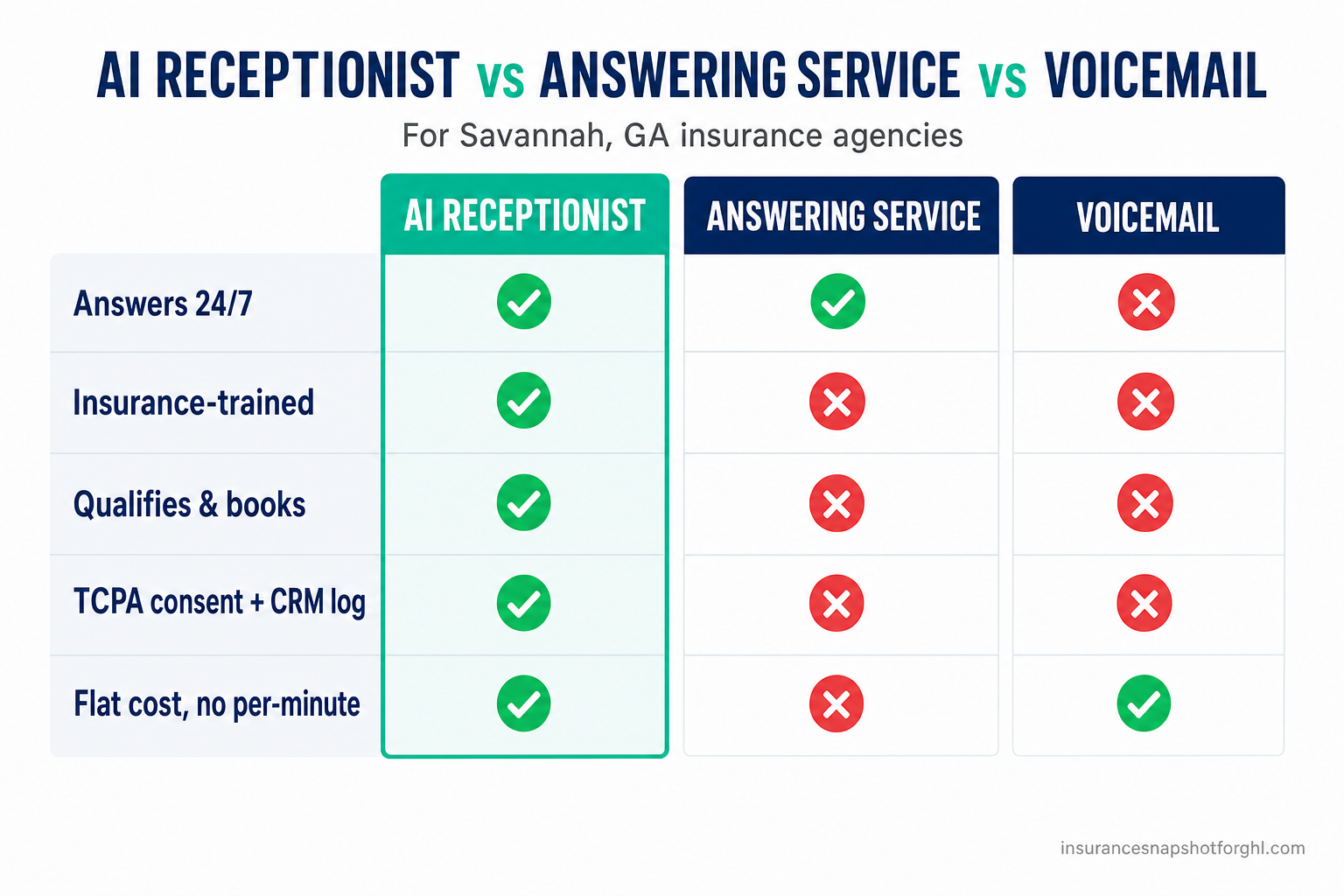
Table of contents
- Why the phone still decides quotes in Savannah
- What each option actually is
- AI receptionist vs answering service vs voicemail: the head-to-head
- Speed to lead: why seconds matter
- The real cost of each option
- The Savannah storm-season problem
- Where each option fits
- FAQ
Why the phone still decides quotes in Savannah
Insurance is a phone business, and it is more competitive than it has ever been. J.D. Power’s 2025 study found that 57% of auto insurance customers actively shopped for a new policy in the past year, the highest shopping rate in the study’s history (J.D. Power 2025 U.S. Insurance Shopping Study). Those shoppers don’t wait. They work down a list, and the agent who talks to them first has an enormous advantage.
Digital hasn’t replaced the call — it feeds it. 47% of shoppers now buy through digital channels (J.D. Power 2025 U.S. Insurance Digital Experience Study), and most of those journeys still end with a phone conversation to confirm coverage, ask a question, or bind. For a Savannah agency, the moment of truth is the same as it has always been: the call. The only question is who — or what — answers it.
When a producer is on another line, out on a claim, or gone for the day, the agency has three realistic options for that call: an AI receptionist, a live answering service, or voicemail. They are not equivalent.
What each option actually is
Voicemail (or an in-house receptionist who’s stepped away). The default. The caller hears a greeting, maybe leaves a message, and waits for a callback. Most quote shoppers won’t wait — they hang up and dial the next agency while they’re still in a buying mood.
A live phone answering service. A third-party call center answers in your agency’s name, follows a short script, takes a message, and relays it. It’s staffed by generalists who answer for dentists, plumbers, and law firms too, so they don’t know your carriers, your lines, or what a renewal X-date is. They bill by the minute — commonly $0.75 to $1.75 per minute plus a monthly plan (AMBS Call Center pricing) — and after-hours and overflow usually cost more.
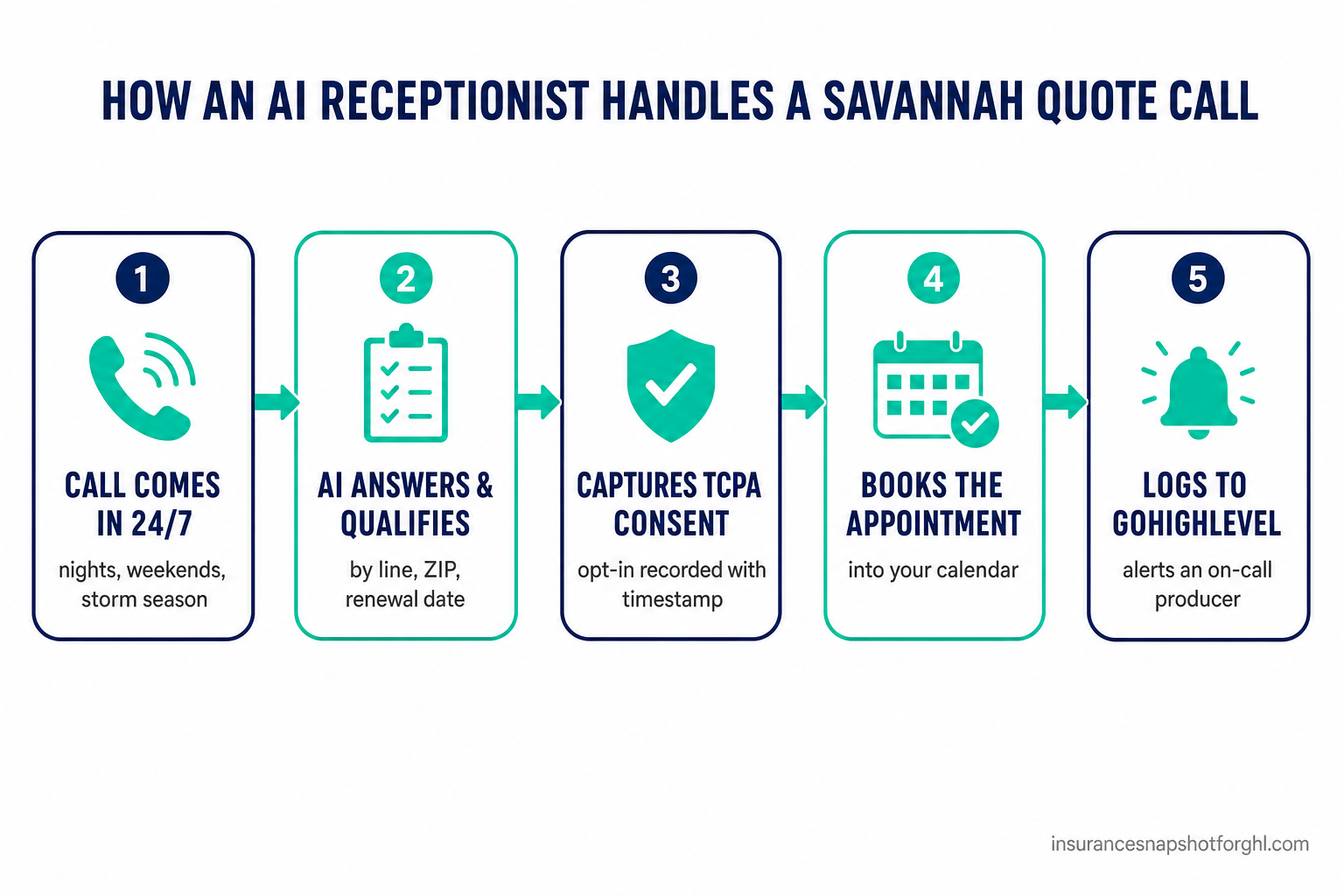
An AI receptionist (AI caller). A voice agent that answers every call instantly, 24/7, in a natural conversation. For insurance it’s trained on your lines of business and common questions, so it does four jobs a message-taker can’t: it qualifies the caller (auto, home, commercial; ZIP; current carrier; renewal date), captures a TCPA-compliant opt-in, books the quote appointment into your calendar or routes an urgent call to an on-call producer, and logs everything into your CRM so the lead lands in the same pipeline as every other. It’s the version of “always answered” that actually moves the policy forward instead of just writing down a name.
AI receptionist vs answering service vs voicemail: the head-to-head
Here’s the honest comparison across the things that decide whether a Savannah quote call becomes a bound policy.
| What matters | AI Receptionist | Live Answering Service | Voicemail / Missed |
|---|---|---|---|
| Answers 24/7 (nights, weekends) | Yes, always | Yes (usually costs extra) | No |
| Speed to answer | Instant, first ring | Rings, then a human picks up | N/A |
| Insurance & quote knowledge | Trained on your lines & FAQs | Generic script, no line-of-business depth | None |
| Qualifies by line, ZIP, X-date | Yes | Rarely | No |
| Books the appointment | Yes — into your calendar | Sometimes (message only) | No |
| Captures TCPA consent + logs to CRM | Yes, timestamped in GoHighLevel | Manual message relay | No |
| Handles storm-season call spikes | Unlimited, no busy signal | Overflow fees, hold times | Voicemail box fills up |
| Escalates urgent calls to a producer | Yes, on your rules | Yes | No |
| Cost model | Flat install, no per-minute meter | Per-minute + monthly plan | “Free” — but leads walk |
The pattern is clear: voicemail loses the lead, a live answering service captures a message but not a qualified, booked appointment, and an AI receptionist captures the whole thing and drops it into your pipeline ready for a producer.
Speed to lead: why seconds matter
The single biggest reason to answer with an AI receptionist instead of a message service is speed. The classic MIT/InsideSales Lead Response Management study found that responding within five minutes instead of thirty makes you 100x more likely to reach the lead and 21x more likely to qualify it (MIT/InsideSales). Harvard Business Review’s audit of thousands of firms found the same shape from the other side: companies that tried to contact a lead within an hour were about 7x more likely to have a meaningful conversation with a decision-maker than those who waited even 60 minutes — yet the average firm took 42 hours to respond (Harvard Business Review, “The Short Life of Online Sales Leads”).
How much more likely you are to reach and qualify a web lead when you respond within 5 minutes instead of 30 (multiple vs a 30-minute response). Source: MIT / InsideSales Lead Response Management Study.
A live answering service can’t beat an AI receptionist here by definition: it adds a ring, a hold, a script, and then a callback from your producer later. An AI receptionist collapses that to seconds — the caller is qualified and booked while they’re still on the phone, in the same window where the research says the odds are highest. This is the same speed-to-lead advantage covered in our playbook, applied to the phone instead of the web form.
The real cost of each option
Cost is where the three options diverge most, and where the per-minute model of a live answering service quietly adds up. An in-house receptionist to cover the phones runs about $37,230 per year in median pay before benefits (U.S. Bureau of Labor Statistics, Receptionists) — and still doesn’t cover nights, weekends, or lunch. A live answering service avoids the salary but meters every call at roughly $0.75–$1.75 per minute on top of a monthly plan (AMBS Call Center), so a busy month — or a storm week — is an unpredictable bill.
An AI receptionist flips the model: it’s a flat setup that then runs inside your GoHighLevel account, with no per-minute meter, no overtime, and no busy signal, whether it handles 10 calls or 500.
What it costs to answer the phone. In-house receptionist = median annual salary (BLS); live answering service = a typical annualized plan at ~$275/mo (AMBS, before per-minute overage); AI receptionist = the one-time Insurance Snapshot install, which then runs on your existing GoHighLevel. Figures are illustrative of the cost model, not a quote.
The bigger point isn’t the setup cost — it’s the marginal cost. A live service charges more exactly when you’re busiest. An AI receptionist’s cost doesn’t move with call volume, which matters enormously in a coastal market.
The Savannah storm-season problem
There’s a local reason this comparison matters more on the Georgia coast than almost anywhere. When a tropical system threatens the Southeast, agency phones don’t ring a little more — they spike. Policyholders call about coverage, deductibles, and claims while new shoppers scramble to bind before a moratorium. The 2024 season made the stakes concrete: Verisk estimated U.S. insured losses from Hurricane Helene at $6 billion to $11 billion, with Georgia among the hardest-hit states (Verisk).
A message-taking answering service is the worst possible tool for that moment: hold times climb, overflow fees kick in, and your callers — anxious and shopping — hang up and try the next agency. An AI receptionist answers every one of those calls at once, with no busy signal, triages the true emergencies to your on-call producer, and books the rest. For a Savannah or Chatham County agency, the storm-season spike is exactly when “we answer every call” has to be literally true.
Where each option fits
To be fair to each option:
- Voicemail is fine as a last-resort backstop — but it should never be your primary answer for a quote line. It’s where leads go to die.
- A live answering service can make sense for pure message-taking or claims triage when you specifically want a human voice and don’t need qualification, booking, or CRM logging — and you’re comfortable with a per-minute bill.
- An AI receptionist is the right default for the quote line: instant, insurance-aware, always on, and connected to the system that actually follows up. It’s what turns “we missed a call” into “we booked the appointment.”
Most agencies we work with don’t want to babysit any of it. That’s what the done-for-you GoHighLevel VA and the full Insurance Snapshot are for — the AI receptionist is installed, tuned to your lines, and running, alongside the rest of your automation, in about a day.
Once it’s live, the payoff compounds. Every answered call becomes a qualified, booked appointment instead of a maybe, flowing straight into the pipeline your quote funnel and renewal cadence already run — so the household you captured at 11pm gets nurtured, cross-sold, and retained on autopilot. Pair the AI caller with an AI chat widget for the shoppers who type instead of call, and both front doors are covered.
FAQ
What is an AI receptionist for an insurance agency?
It's an AI voice agent that answers your agency's phone 24/7 in a natural conversation. For insurance, it's trained on your lines of business and common questions, so it does four jobs a message-taker can't: it qualifies the caller (auto, home, or commercial; ZIP; current carrier; renewal date), captures a TCPA-compliant opt-in, books the quote appointment into your calendar or routes urgent calls to an on-call producer, and logs everything into your CRM. The agency's licensed staff still quote, advise, and bind — the AI just makes sure no call is missed and every lead is qualified and booked.
How is an AI receptionist different from a live answering service?
A live answering service is a third-party call center staffed by generalists who answer for many industries. They follow a short script, take a message, and relay it — they don't know your carriers, your lines, or what a renewal X-date is, and they bill by the minute (commonly $0.75–$1.75/min) plus a monthly fee. An AI receptionist answers instantly, is trained specifically on your insurance lines, qualifies and books the appointment, captures consent, logs to your GoHighLevel CRM, and doesn't meter you per minute or hit a busy signal when call volume spikes.
Why does this matter specifically for a Savannah, GA insurance agency?
Coastal Georgia sees sharp call-volume spikes during hurricane season — Verisk estimated U.S. insured losses from Hurricane Helene in 2024 at $6–11 billion, with Georgia among the hardest-hit states. That's exactly when a message-taking service racks up overflow fees and hold times while anxious shoppers hang up and call the next agent. An AI receptionist answers every call at once, with no busy signal, triages true emergencies to your producer, and books the rest — so the storm-season surge becomes captured business instead of lost calls.
Is an AI receptionist TCPA compliant?
It is when it's built correctly. A proper setup discloses that the caller is speaking with an automated assistant, presents clear consent language before capturing a phone number for follow-up texting or calling, records that consent with a timestamp in the CRM, offers a path to a human, and honors STOP/HELP opt-outs. The agency remains the licensed party — the AI receptionist captures, qualifies, and books, but does not quote, bind, or give coverage advice.
How much does an AI receptionist cost compared to an answering service?
The models are different. A live answering service meters every call (roughly $0.75–$1.75/minute) on top of a monthly plan, so your bill rises exactly when you're busiest. An in-house receptionist to cover the phones runs about $37,230/year in median pay (BLS) and still doesn't cover nights and weekends. An AI receptionist is a flat install — as part of the Insurance Snapshot it goes into your existing GoHighLevel with no per-minute meter and no overtime, whether it handles 10 calls or 500 in a storm week.
How long does it take to set up an AI receptionist?
As part of the Insurance Snapshot for GHL, the AI receptionist installs into your GoHighLevel account in about 24 hours, already wired to your quote funnels, appointment calendar, renewal cadence, and TCPA-safe SMS. Because it's one feature inside the whole system rather than a disconnected call center, a call answered after hours enters the same pipeline and follow-up as every other lead.
About the author
Andre Bellamy is the GHL Automation Lead for the insurance practice at Insurance Snapshot for GHL. He builds and tunes the GoHighLevel workflows behind the Snapshot — AI caller and chat, quote funnels, renewal cadences, and TCPA-safe SMS — and spends his days inside agency accounts mapping how a call actually becomes a bound policy. He writes about the operational mechanics: trigger timing, pipeline stages, and the small decisions that separate “kind of works” from a system an agency can trust. Editorial byline only — Andre is not a licensed agent and does not quote, bind, or sell insurance.
Want every quote call answered? See the AI caller feature, book a 30-minute demo, or talk to a real person.
Related posts
- Speed to Lead for Insurance Agencies: The 5-Minute Rule That Wins More Policies
- AI Receptionists for Insurance Agencies: Answer Every Call, Quote After Hours
- Why Miami Insurance Agencies Lose After-Hours Leads — and How an AI Chat Widget Wins Them Back
- TCPA-Safe Insurance SMS: The Compliance Playbook