
It is renewal season, your book has grown to about 1,800 policies, and the Applied Epic invoice just landed with another per-seat line for the CSR you hired in March. It still takes six clicks to log a call, and you are a four-person shop paying enterprise money for a tool built for agencies ten times your size. That is the moment most owners start typing “Applied Epic alternative for a small agency” into Google. Here is the honest answer: if you run under about 15 users, the best Applied Epic alternatives in 2026 are EZLynx, HawkSoft, Momentum AMP (formerly NowCerts), and, as a sales-and-retention layer on top of whatever you keep, AgencyZoom. Which one fits depends on your rating needs, contract tolerance, and how ugly your data is to move.
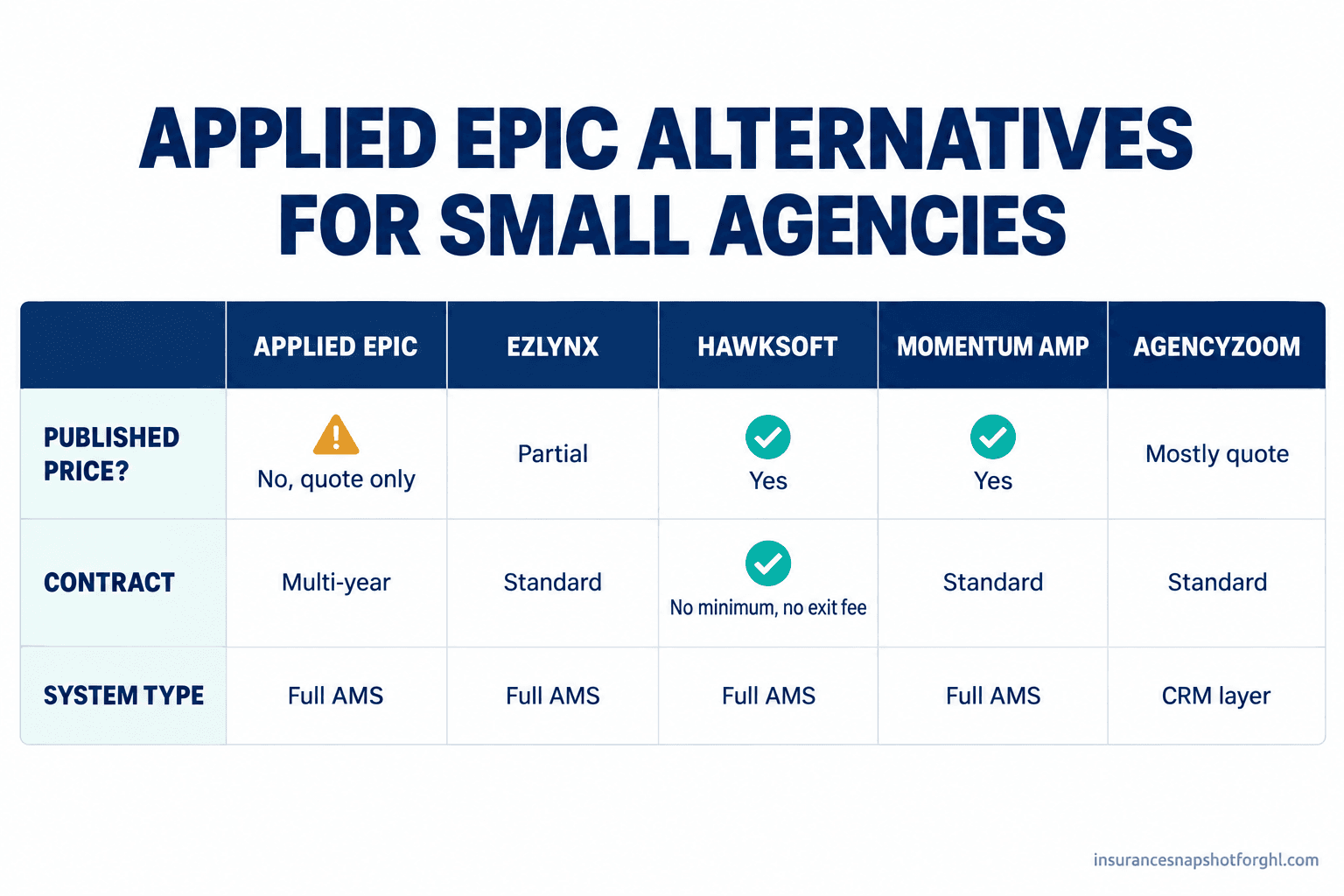
Table of contents
- Why small agencies leave Applied Epic
- The eight things to judge an alternative on
- The four best Applied Epic alternatives, compared
- Solo, five-producer, and large: who should pick what
- How a migration actually breaks, and how to survive it
- Steal this: the export request and the price-forcing script
- The compliance layer switching software does not fix
- Objections
- FAQ
Why small agencies leave Applied Epic
Applied Epic is a powerful system of record. That is not the complaint. The complaint is that it is priced and built for agencies with dozens of users, and a small shop pays for depth it never touches. Independent agents place 61.5% of all U.S. property and casualty premium, per the Big “I” 2025 Market Share Report with Future One (Insurance Journal), and a big share of that book sits inside two-to-ten-person agencies. Those owners feel three things.
First, the price is a mystery until you are deep in a sales cycle. Applied publishes no list price; Capterra and every aggregator just say contact the vendor for a modular quote (Capterra). Third-party trackers estimate the license around $150 per user per month, with implementation in the five figures for a small agency (ITQlick). Those are tracker estimates, not numbers Applied stands behind, and you cannot budget against a figure nobody will put in writing.
Second, every hire raises the bill: per-seat pricing scales your software cost with your payroll whether or not that person is producing.
Third, the daily work does not match the tool. A small agency logs a call, quotes a renewal, and chases a document. It does not need the full enterprise download-and-accounting stack under every click, and when the interface makes simple things slow, producers stop logging activity. An AMS nobody updates is worse than a cheaper one everyone uses.
Leaving is still a real decision, so before you shop, get clear on what matters for a shop your size.
The eight things to judge an alternative on
Do not compare on monthly price alone. That is the number vendors want you to fixate on because it hides the rest. Judge every option on eight things:
- Published, honest pricing. Can you see a real number without a sales call?
- How users are priced. Flat tiers, per-user, or base plus per-user. This decides what your fifth hire costs.
- Setup and data-migration cost. The one-time fee that ambushes people. Get it capped in writing.
- Contract length and exit terms. Month-to-month, or a multi-year auto-renew with a termination fee.
- Data-export fees on the way out. Some vendors charge to hand back your own book. One publicly will not.
- Comparative rating. Built in, or a separate bolt-on you pay for again?
- Carrier download and accounting depth. How complete the record side is.
- Who it is built for. Solo, small team, or growing multi-location.
The chart below shows the entry pricing gap that starts every one of these conversations. Applied Epic is plotted at a third-party estimate for a small multi-user setup, since it publishes nothing.
Reported monthly entry pricing, U.S., 2026. Sources: SoftwareFinder, G2, HawkSoft, SelectHub, ITQlick. Applied Epic publishes no price; its bar is a third-party estimate.
The four best Applied Epic alternatives, compared
Here is each option, what it really costs, and how it breaks. The full raw-pricing teardown across every AMS lives in our companion piece on what agency management software costs in 2026. This post is about the switch.
EZLynx: the rating-first choice
EZLynx is the option most small P&C shops reach for first, because comparative rating is baked into the core rather than bolted on. If your day is quoting the same risk across six carriers, that matters more than anything else here.
Pricing is modular. Rating-focused entry is commonly cited near $129 a month, while a fuller package with the management system runs closer to $350 a month (SelectHub). EZLynx does not publish one flat rate (EZLynx); life and health rating and add-ons cost extra.
How it breaks: owners who buy the rating-only tier expecting a full AMS get surprised when management features sit behind another line item. Make the rep itemize every module against your lines of business before you sign.
HawkSoft: the no-games contract
HawkSoft is the answer for the owner who distrusts hidden fees most. It uses a base-plus-per-user model, starting around $250 a month plus about $94 per user (HawkSoft). More important than the number is the posture: HawkSoft states plainly that it has no minimum-length contracts, no early-termination fees, and no data-extraction fees if you ever leave. In a market where the exit is the trap, that is worth real money.
How it breaks: the per-user fee means the bill climbs with headcount, the same issue as Epic at a friendlier base. Model the cost at the team size you expect in two years.
Momentum AMP (formerly NowCerts): the transparent budget pick
NowCerts rebranded to Momentum AMP, the most price-transparent option here: Essentials at $99 a month for one user, Professional at $169 for two, and Business at $349 for up to five, with additional users at $45 each and a custom Enterprise tier above 50 (SoftwareFinder, GetApp). That flat-tier model is friendlier to a growing team than an Epic-style seat model.
How it breaks: the lowest tier is genuinely lean. Agencies that need deep carrier download or heavy accounting outgrow it, so buy for the workflow you run in 18 months, not the demo.
AgencyZoom: not a replacement, a layer
AgencyZoom is different from the other three. It is a sales-automation and retention CRM that Vertafore acquired in November 2021, and it sits on top of an AMS rather than replacing one (Vertafore). Pricing is mostly quote-based but commonly reported around $149 to $349 a month, roughly seven seats included (G2). It is genuinely good at pipeline and renewal tracking.
How it breaks: owners buy it expecting an AMS replacement and find it does not download policies or run accounting. It is a layer, not a system of record, so if you move to a cloud AMS with its own pipeline tools you may not need it.
The matrix below puts the four side by side against the eight criteria.
| Criterion | EZLynx | HawkSoft | Momentum AMP (NowCerts) | AgencyZoom |
|---|---|---|---|---|
| Published price | Partial (modular) | Yes (guide) | Yes (tiers) | Mostly quote |
| Entry cost/mo | ~$129 to $350 | ~$250 base | $99 | ~$149 to $349 |
| User pricing | Per package | Base + $94/user | Flat tier + $45/user | Seats bundled |
| Built-in rating | Yes (core) | Via integration | Via integration | No |
| Contract terms | Standard | No minimum, no exit fee | Standard | Standard |
| Data-export fee | Confirm | None (stated) | Confirm | N/A (layer) |
| System of record | Full | Full | Full | No (add-on) |
The most common quoting mistake is stacking EZLynx rating-only pricing against a full-AMS price. Compare complete configurations to each other, same lines of business and user count.
Solo, five-producer, and large: who should pick what
The right answer changes with your size. Run the same eight criteria through three shapes of agency and you get three winners.
The solo or two-person shop. Cash flow is the constraint, and every dollar of software is a dollar not spent on leads. Momentum AMP at $99 to $169 a month gives you a real cloud AMS with a price you can see today. If comparative rating is your bread and butter, EZLynx at the rating tier is the exception worth the demo. Applied Epic at an estimated five-figure implementation is the wrong tool at this size.
The five-producer agency. The classic Epic-escape shop: enough people that per-seat pricing hurts, enough volume that the AMS has to be solid. HawkSoft is the natural fit. The base-plus-user model is predictable, the workflows are built for service, and the no-minimum-contract stance means you are not betting the agency on a three-year commitment while you grow. If your producers live in a rater all day, EZLynx competes hard.
The larger or multi-location agency. At 15-plus users with heavy accounting, complex carrier downloads, and multiple locations, the depth of Epic or AMS360 can be worth the price, and ripping it out mid-growth is risky. This is where a layer strategy wins: keep the heavy system of record and add AgencyZoom or a dedicated automation layer for sales and retention, rather than forcing the AMS to market.
Disclosure: the GoHighLevel link above is an affiliate partner link; you pay the same price.
How a migration actually breaks, and how to survive it
The software choice is the easy part. The migration is where agencies lose weeks. The failure modes I see most:
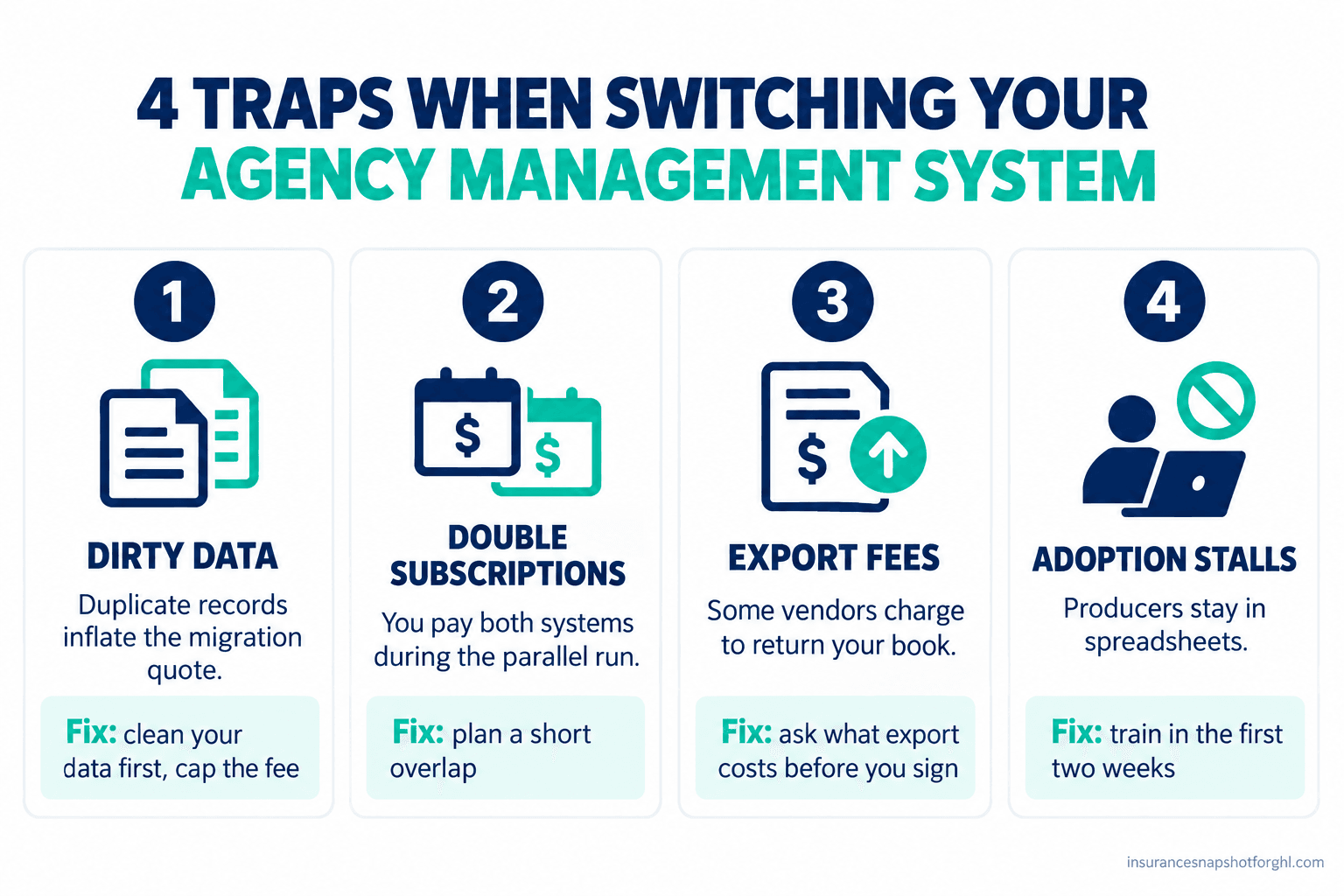
Dirty data becomes a surprise bill. Setup quotes assume clean records. Real agency data has duplicate contacts, half-filled fields, and ten years of inconsistent tags, and when the conversion vendor hits that mess, the “estimate” moves. Migrations off Epic and AMS360 typically route through third-party conversion specialists like RecordLinker (RecordLinker), whose price depends on how ugly your export is. Run a data-cleanliness pass first and get the migration fee capped, not estimated.
The overlap you pay twice for. You run both systems in parallel while you validate the new one, which means two subscriptions for a month or two. Users report legacy contracts that auto-renew and cannot be canceled during that overlap, so read the termination clause before you pick a start date.
The export fee ambush. Some vendors charge to hand you your own book on the way out, which is why HawkSoft advertising no data-extraction fee is worth noting: it implies the silent ones may bill you. Ask every new vendor: “If I leave in three years, what does it cost to get my data out?” A vendor that will not answer cleanly is telling you something.
Producer adoption stalls. The best migration fails if producers keep working out of spreadsheets because the new system feels foreign. Budget training in the first two weeks and pick one internal owner to validate every migrated field. We walk through a full sequenced move in our GoHighLevel migration playbook, and the same discipline applies to any AMS switch.
Steal this: the export request and the price-forcing script
Two pieces of copy that save you real money. Use them verbatim.
1. The data-export request. Send this to your current vendor before you sign anything new, so you know your exit cost while you still have room to negotiate.
Subject: Data export terms for our account

Hi [rep name],

We are reviewing our systems for 2026 and need our exit terms in writing:

1. If we terminate, the full cost to export our complete book (contacts,
   policies, activity notes, documents, attachments)?
2. What formats do you export in, and how long does it take?
3. Any data-extraction, offboarding, or "assistance" fees?
4. What notice period and early-termination terms apply?

Please send specific figures and clauses, not a general description.

Thanks, [Your name]
2. The price-forcing script for the Applied Epic or AMS360 demo. When the rep will not give a number, this pins them down:
"Before we book more time, I need three numbers in writing:

  1. The all-in monthly license for exactly [X] users, itemized by module.
  2. The one-time implementation and data-migration fee, capped.
  3. Contract length, auto-renewal terms, and any early-termination fee.

If you can email those today, we stay in the process. If pricing only
comes at the end, we will focus on vendors who published theirs.
Which is it?"
That script reframes the demo: you are not a lead to be nurtured, you are a buyer with published alternatives, which is the upper hand a small agency usually forgets it has.
The compliance layer switching software does not fix
Changing your AMS does not change the rules your outreach lives under. Three things stay your responsibility.
TCPA and A2P 10DLC. If you text clients, you need registered business messaging. All major U.S. carriers require A2P 10DLC registration through The Campaign Registry, and unregistered traffic is now blocked, not throttled (Infobip). One correction many vendors get wrong: the FCC’s one-to-one consent rule does not apply. The 11th Circuit vacated it on January 24, 2025, and the FCC removed the rule text effective August 29, 2025 (FCC). Consent reverts to the prior express written consent standard.
Life and annuity advertising. If you sell those lines, NAIC Model 570, as adopted by your state, governs your advertising. Testimonials must be genuine, current, and accurately reproduced, and any paid endorsement disclosed as such (NAIC). Automated review and testimonial campaigns trip this, so build the disclosure into the template. We cover the gift and testimonial rules in our marketing compliance guide.
Anti-rebating. Client-appreciation and referral-gift automation runs straight into state rebating caps, which differ sharply by state. Your software vendor will not keep you compliant; your process will.
Objections
“We already pay for Applied Epic. Isn’t switching just more cost?” Sometimes staying is right, especially at scale. But run the three-year number, not the monthly one. Add the per-seat cost of your next two hires and compare against a base-plus-user or flat-tier alternative. For many small shops the switch pays for itself inside a year, migration included.
“Migrating my whole book sounds terrifying.” It is real work, not magic. The way through is a capped migration quote, a data-cleanliness pass first, a parallel-run period, and one internal owner validating fields. The agencies that suffer skipped the cleanup and read the contract too late.
“Do I need to be technical to run one of these?” No. Momentum AMP and HawkSoft are built for agency staff, not IT departments. The learning curve is real for two weeks, then it is muscle memory.
“Which one is actually the best?” There is no single best, and any article naming one for everyone is selling something. It is a function of your size, rating needs, and contract tolerance. Match those to the three scenarios above.
The layer your new AMS still will not cover
Here is the part every AMS comparison skips: your system of record stores and organizes, but it does not market. It does not text a missed caller back in 60 seconds, run a 120/60/30/7 renewal cadence, or ask a happy client for a review after a bind. That work is what moves retention, and retention is the whole game. Industry benchmarks commonly cited put average agency client retention near 84%, with the best-run shops at 93% to 95% (Agency Performance Partners). With 572,600 insurance sales agents chasing the same households (BLS), the agency that follows up automatically keeps the renewal. The cleaner model is a dedicated automation layer on top of whatever AMS you land on, connected through the integrations that link your AMS, dialer, and rater, with the cadences in our retention playbook. Pick the AMS that fits your book, then put follow-up on autopilot.
FAQ
What is the best Applied Epic alternative for a small agency?
There is no single best. Momentum AMP (formerly NowCerts) from $99/mo is the transparent budget pick, HawkSoft at about $250/mo plus $94/user fits a contract-averse five-producer shop, and EZLynx wins for rating-heavy P&C shops.
How much does Applied Epic actually cost?
Applied Epic publishes no list price; you get a modular quote after a demo. Third-party trackers estimate the license around $150 per user per month with five-figure implementation for a small agency, but those are estimates, not quotes Applied stands behind.
Is NowCerts the same as Momentum AMP?
Yes. NowCerts rebranded to Momentum AMP. Published tiers run from $99/mo for one user up to a $349/mo Business tier for five, plus $45 per additional user.
Will I get charged to export my data when I leave an AMS?
Sometimes. Some vendors bill a data-extraction fee to hand back your own book. HawkSoft publicly states it charges none and has no minimum contract. Ask every vendor what export costs before you sign.
Does the FCC one-to-one consent rule apply to insurance texting?
No. The 11th Circuit vacated it on January 24, 2025, and the FCC removed the rule text effective August 29, 2025. Consent reverts to the prior express written consent standard. You still need A2P 10DLC registration and TCPA-compliant opt-out handling.