
You set up one automation: every client who binds gets a $50 gift card and a text asking for a five-star Google review. It feels like good service. Depending on your state and wording, it is also two violations stacked on each other. The gift may blow past your state’s rebating cap, and a gift card tied to leaving a review breaks a federal FTC rule and Google’s policy. Nobody sent a warning. Automation just did it 400 times before anyone noticed.
Here is the short version. Insurance marketing is governed by three bodies of law most agencies never read: anti-rebating rules that cap what you can give, advertising rules that govern testimonials, and consumer-review rules from the FTC and the platforms. Automation does not break these rules. It scales whatever you built, compliant or not, to your entire book. This guide walks all three and gives you copy to drop into your workflows.
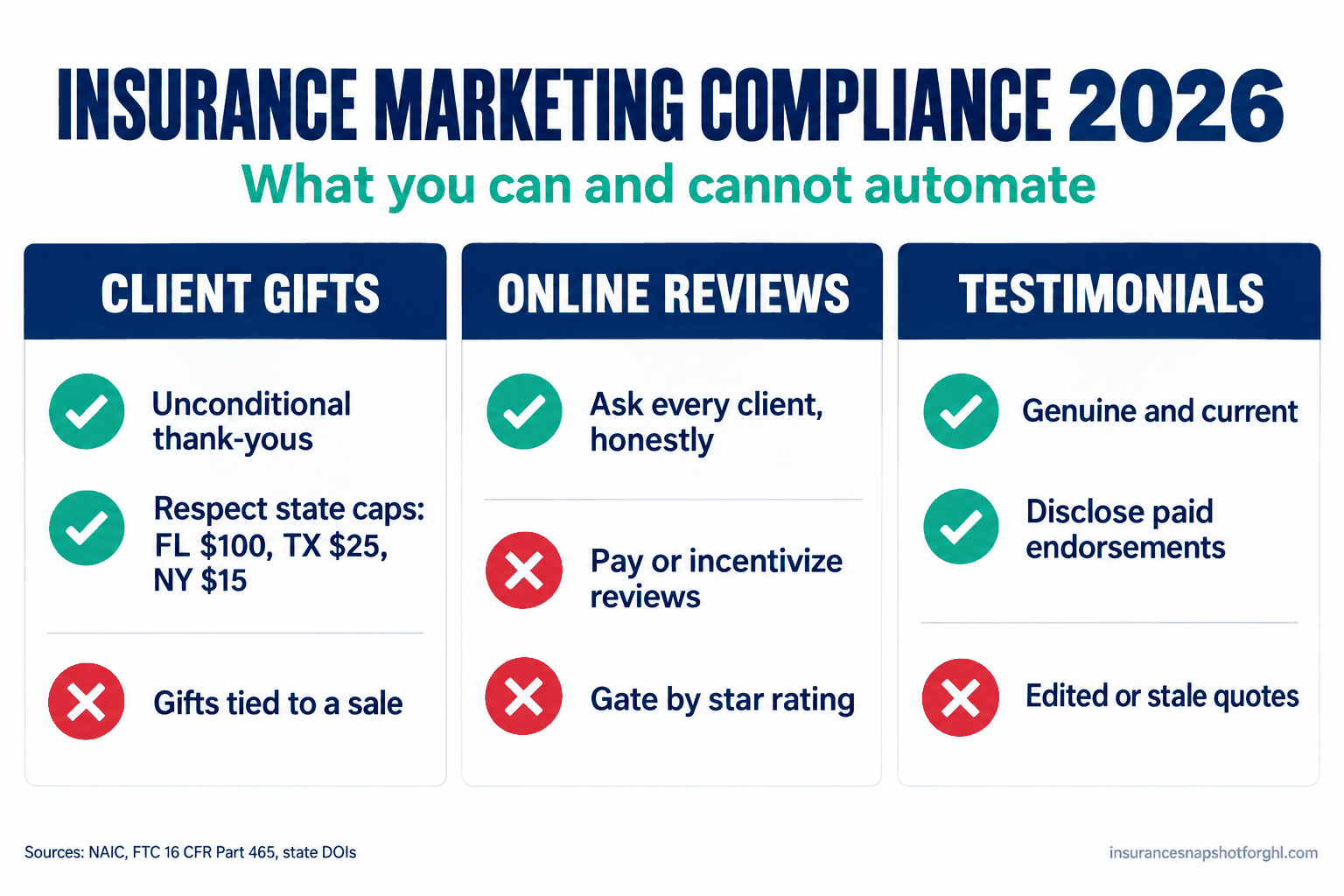
Table of contents
- The three laws hiding inside your marketing automation
- Client gifts and incentives: what anti-rebating law lets you give
- Online reviews: what you can and cannot ask for
- Testimonials and endorsements in your advertising
- Texting the campaign: TCPA and the rule that no longer applies
- Steal this: compliant copy for your automation
- How it plays out for a solo, a mid-size, and a large agency
- Objections
- FAQ
The three laws hiding inside your marketing automation
Most agency owners think of compliance as a texting problem, because TCPA is the one that gets talked about. It is bigger than that. When you automate marketing, you touch three separate rulebooks at once:
- Anti-rebating law governs what you can give. Most states model it on the NAIC’s Unfair Trade Practices Act, Model 880 (NAIC): you cannot give a client or prospect something of value, outside the policy, to induce the sale. The dollar limits live in each state’s statute.
- Advertising law governs what you say. NAIC Model 570 sets standards for life and annuity ads, including rules on testimonials (NAIC), and the FTC’s Endorsement Guides add constraints across all industries.
- Consumer-review law governs how you collect reviews. The FTC’s 2024 rule bans fake and undisclosed incentivized reviews (FTC), and the platforms add their own policies.
None of this is exotic. It becomes dangerous when you automate, because a workflow does not use judgment: it fires the same message to everyone. If it quietly crosses a line, it crosses it across your whole book, and every send is a separate potential violation.
Client gifts and incentives: what anti-rebating law lets you give
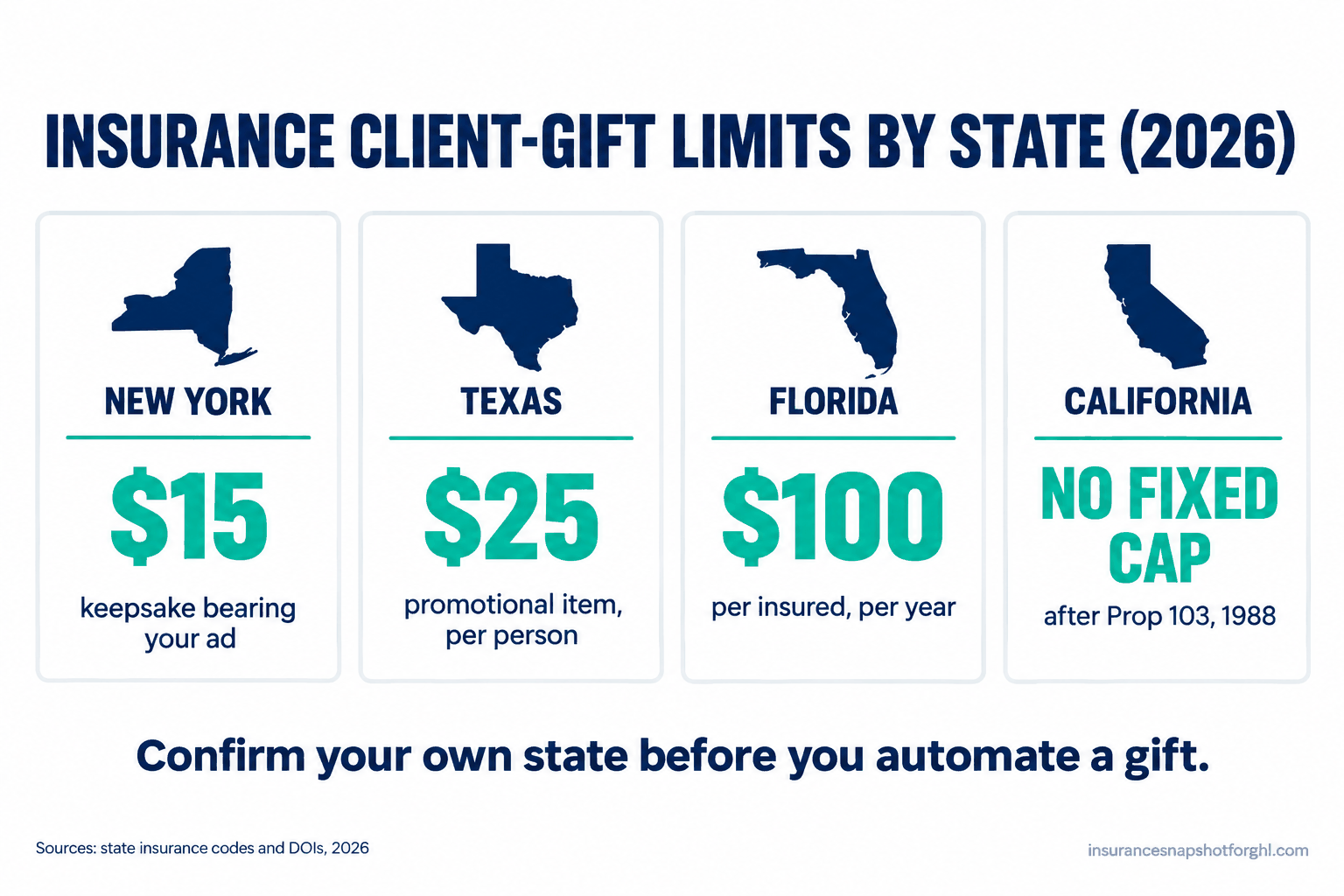
This is the one that catches good intentions. A thank-you to a loyal client or a closing gift is reasonable, but in insurance a gift to a client or prospect can be treated as an inducement, and your state caps the value. The caps are not uniform, and the spread is wide.
| State | Gift / inducement limit | Basis |
|---|---|---|
| Florida | Up to $100 per insured or prospect, per calendar year | Fla. Stat. 626.9541 (raised from $25) |
| Texas | Up to $25 per person for promotional or advertising items | Tex. Ins. Code 4005.053(d) |
| New York | Up to $15 for a keepsake bearing the agency’s ad | NY Ins. Law 2324 (DFS opinions) |
| California | No fixed dollar cap; rebating largely deregulated | Prop 103 (1988), Cal. Ins. Code 750 |
Sources: Florida Senate, Texas Legislature, NY DFS OGC, Justia (Cal. Ins. Code 750).
Florida raised its limit to $100 per insured per calendar year, a real jump from the old $25 (Colodny Fass). Texas stays conservative at $25 for promotional items. New York is stricter still, allowing only a $15 keepsake that carries your advertisement. California is the outlier: after Proposition 103 passed in 1988, it does not enforce a bright-line cap the way the other three do. The lesson is not the exact figures, which change, but that a single flat gift rule applied across states is wrong somewhere.
Per-client gift / inducement caps in 2026, in dollars (California enforces no fixed cap). Sources: Fla. Stat. 626.9541, Tex. Ins. Code 4005.053, NY DFS.
How this breaks in an automation
The failure is almost never a deliberate bribe. It is a workflow that ignores three things.
The per-year total. Your cap is usually per person per calendar year, not per gift. A $60 closing gift in March plus a $60 holiday gift in December is $120 to one Florida client in a year, over the line. An automation that sends both without tracking the running total is the classic trap.
Conditional versus thank-you. The safest gifts are unconditional. A gift contingent on binding, renewing, or referring reads more like an inducement. A trigger of “policy bound, send gift card” ties the gift to the sale by design, exactly the pattern the law limits.
State. A $50 gift is fine in Florida and a violation in Texas and New York. Segment by the client’s state before any gift fires, or set every gift to the lowest cap you operate under.
The clean fix: cap the value at or below your strictest state’s limit, keep gifts unconditional, log the value per contact, and skip cash-equivalents that look like a rebate. For paying people to send you business, a different and more regulated question, see our insurance referral programs playbook.
Online reviews: what you can and cannot ask for
Reviews are some of the best marketing an agency has, and the rules got sharper in 2024. Offering a $10 gift card for a Google review is now a genuinely bad idea on two fronts.
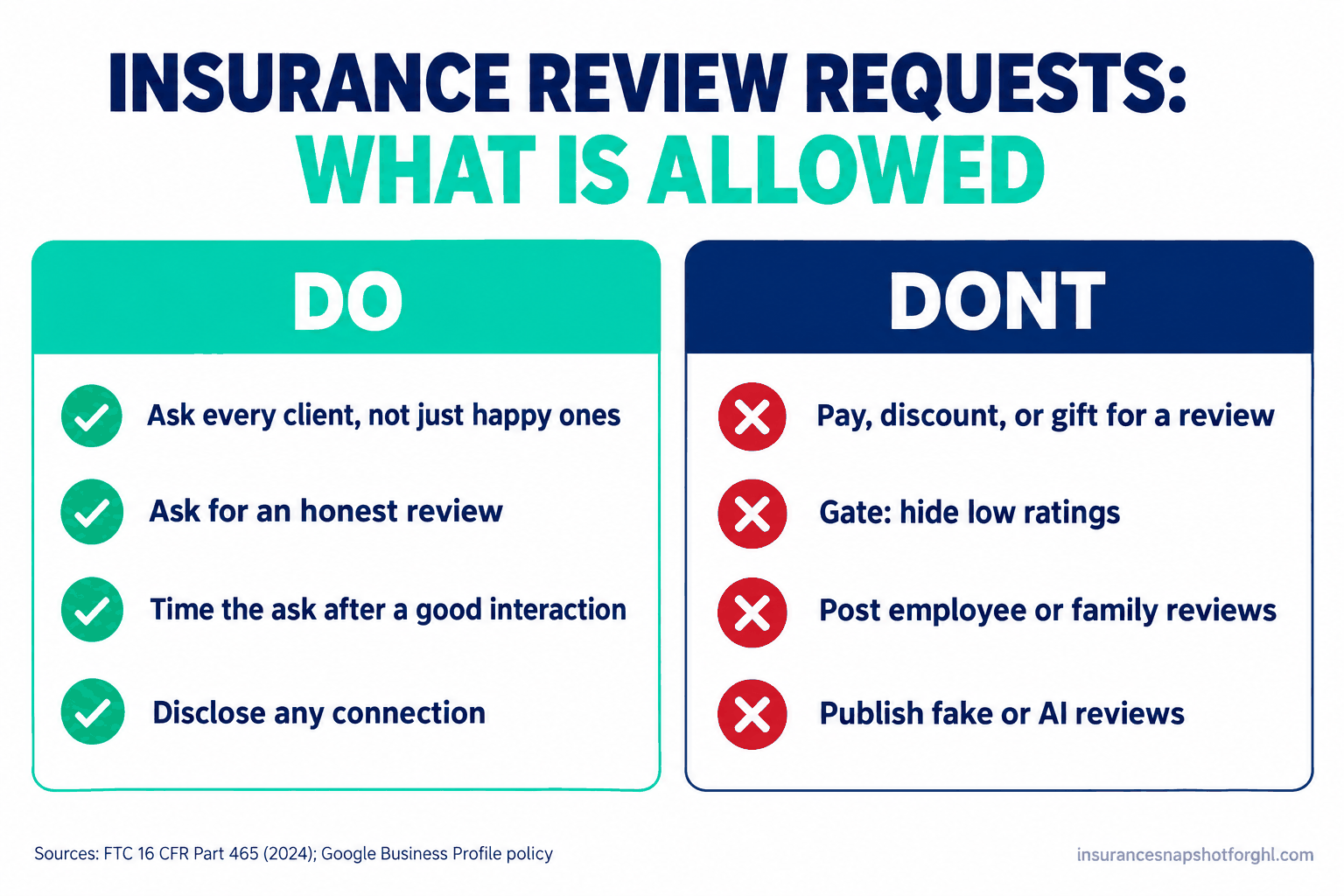
The FTC rule. The Rule on the Use of Consumer Reviews and Testimonials, 16 CFR Part 465, took effect on October 21, 2024 (FTC). It bans fake and AI-generated reviews, buying reviews, and any incentive conditioned on the review’s sentiment. You cannot pay, discount, or gift someone for a positive review. Penalties run up to $51,744 per violation (eCFR), and each send is its own exposure.
The FTC Endorsement Guides. Separately, 16 CFR Part 255 requires any material connection between you and a reviewer (payment, a free service, employment, a family tie) to be disclosed clearly (eCFR). Your cousin at the front desk is fine, but the connection must be visible.
Google’s own policy. Google Business Profile prohibits offering incentives for reviews, fake engagement, and reviews with a conflict of interest, such as an employee reviewing the agency (Google). Violations get reviews removed and can put the whole profile at risk.
A quieter trap is review gating: surveying first and only routing happy clients to Google while steering unhappy ones to a private inbox. That is the selective solicitation the platforms and the FTC frown on. Ask everyone the same way.
So what can you do? Ask every client for an honest review, at a well-chosen moment, through automation, as long as you do not pay for it, condition anything on the rating, or filter by sentiment. The common failures are the reverse: “leave a 5-star review and get a $10 gift card” (a conditioned incentive), a survey that forwards only 4 and 5-star responses (gating), and staff posting reviews without disclosing the connection. We cover the timing and wording in our Google reviews playbook and the review harvesting deep dive.
Testimonials and endorsements in your advertising
A review lives on a platform. A testimonial takes a client’s words into your own marketing (website, ad, social post, email), which brings in advertising law.
For life and annuity advertising, NAIC Model 570 sets the standard. A testimonial must be genuine, accurately reproduced, current, represent the person’s current opinion, and actually apply to the policy advertised (NAIC). You cannot run a three-year-old quote about a product that has changed, or edit a testimonial to say something the client did not mean.
The rule that surprises people is the disclosure requirement. If the person giving the testimonial is paid, has a financial interest, or is controlled by the agency, that fact must be disclosed. This is the “paid endorsement” line, echoed in the FTC Endorsement Guides for all advertising (FTC). The influencer you paid, the client you rewarded for a video, the producer’s spouse in an ad: all need a clear disclosure that the endorser was compensated or connected.
This compounds with the gift section: give a client something of value for a testimonial and you create two problems at once, an inducement under state rebating law and a paid endorsement that must be disclosed. The cleanest testimonials are unpaid, current, in the client’s own words, and used with written permission.
How this breaks in an automation
A workflow that scrapes five-star reviews and auto-publishes them as testimonials can republish a stale quote, or one from a client who has since left, cutting against Model 570’s “current and genuine” standard. An ask that rewards a video testimonial builds the paid-endorsement problem in from the start. Keep a human on what gets published, get written consent, and if compensation exists, bake in the disclosure.
Texting the campaign: TCPA and the rule that no longer applies
Most of these campaigns reach clients by text, so TCPA and A2P 10DLC still apply. You need prior express consent for marketing texts, clean STOP and HELP handling, and a registered messaging campaign. We cover that end to end in our TCPA-safe SMS field guide.
One thing must be corrected, because it is the most common piece of stale advice in agency marketing right now. The FCC’s “one-to-one consent” rule is not in effect. It would have required separate consent for each seller. Scheduled to start January 27, 2025, it was vacated three days earlier by the Eleventh Circuit in Insurance Marketing Coalition Ltd. v. FCC, which held the FCC had exceeded its authority (opinion, analysis). The FCC then formally removed the rule text later in 2025 (FCC).
If a vendor says you must re-paper all your consent for one-to-one, they are using an outdated playbook. The ordinary TCPA consent standard governs. Keep consent capture clean and documented, and do not let a dead rule scare you into a rebuild.
Steal this: compliant copy for your automation
Here is language you can drop into your workflows, written to stay inside the rules above. Adjust the specifics, then have your compliance contact sign off before it goes live.
The review request (no incentive, no gating, sent to everyone).
Hi [First Name], it is [Agent] at [Agency]. Thanks for trusting us with your coverage. If you have a minute, an honest review really helps other local families find us: [review link]. Good or bad, we read every one. Reply STOP to opt out.
The unconditional client thank-you (kept under your strictest state cap).
Hi [First Name], just a thank-you for being part of [Agency] this year. There is a small [item, value under your state limit] on its way to you. No strings. We appreciate you.
Framed as a gift for being a client, not a reward for binding, renewing, or referring. Keep it under your lowest operating cap and log it.
The testimonial-use consent (for putting a client’s words in your marketing).
Hi [First Name], we would love to feature your kind words on our website. Do we have your written permission to use your name, town, and quote as a testimonial? You can say no, and it changes nothing about your coverage.
Get the yes in writing and keep it. If the client was compensated or connected to the agency, add the disclosure to the asset itself.
The paid-endorsement disclosure (when compensation or a connection exists).
Paid endorsement. [Name] received compensation from [Agency] for this testimonial.
Short, clear, and attached to the quote wherever it runs. That line turns a risky endorsement into a compliant one.
How it plays out for a solo, a mid-size, and a large agency
The rules are the same for everyone. The risk and fix scale with size.
Solo operator (one agent, one state). Small exposure, small margin for error, because one bad automation hits your only book. Keep it simple: one gift value under your state cap, unconditional, and one review request that asks everyone for honest feedback. Just clean copy and the discipline not to bolt an incentive onto the review ask when growth feels slow.
Mid-size team (three to eight producers, sometimes two states). Producers improvise their own thank-yous and review asks, and you may write across a state line where the caps differ. Centralize the templates so everyone uses approved copy, segment gift automations by the client’s state so a $50 gift never fires to a Texas or New York client, and give one person the testimonial process.
Large agency (nine or more producers, multiple states, marketing staff). Your risk is volume and drift. One misconfigured workflow can send thousands of non-compliant messages before anyone reads the report, and a marketing hire who does not know insurance law may import general “best practices,” like incentivized reviews, that are illegal here. You need real controls: gifts capped to your strictest state, per-contact value tracking, state-segmented automations, a documented testimonial process, and a periodic audit. At this size, the automation should enforce the rules so no individual has to remember them.
Objections
“We have given clients gifts for years and never had a problem.” Probably true, and not a defense. Rebating enforcement is complaint-driven, so you can be over the line for years until a competitor complains. Automation raises your profile: it creates a clean paper trail of the same gift to hundreds of people. The fine and the E&O headache are not cheap.
“If we cannot offer anything for reviews, how do we get any?” You ask, at the right moment, every time, through automation. Agencies that ask every client after a good interaction, with no incentive, out-collect the ones that bribe a few, because volume and timing do the work. Consistency is what a workflow is good at.
“Do the federal review rules really apply to a small local agency?” Yes. The FTC rule and the Endorsement Guides apply to businesses of every size, and Google’s policy applies to every profile. Being small just means a penalty hurts more.
The bottom line
Marketing automation does not create compliance risk. It scales the choices you already made. If your gift is unconditional and under your state’s cap, your review ask is honest and offered to everyone, and your testimonials are genuine and disclosed when paid, then automating it is the safest way to run it, because the workflow applies the same rules every time. Get the templates right once, cap to your strictest state, and let the system carry the guardrails.
FAQ
Can insurance agents give gifts to clients?
Yes, within your state's anti-rebating limits. Florida allows up to $100 per insured per calendar year, Texas caps promotional items at $25, and New York limits keepsakes to $15. California enforces no fixed cap after Proposition 103. Keep gifts unconditional, track the annual total per client, and confirm your state's rule with your Department of Insurance first.
Is it legal to offer a gift card for a Google review?
No. The FTC's Rule on Consumer Reviews and Testimonials (16 CFR Part 465, effective October 2024) bans incentives conditioned on a review, with penalties up to $51,744 per violation, and Google separately prohibits it. Ask every client for an honest review instead, with nothing attached.
Do I have to disclose a paid testimonial in insurance advertising?
Yes. NAIC Model 570 requires life and annuity testimonials to be genuine and current, and to disclose when the endorser is paid or connected to the agency. The FTC Endorsement Guides (16 CFR Part 255) require disclosing material connections in all advertising. A short 'Paid endorsement' line satisfies it.
What is review gating and why is it a problem?
Review gating is surveying clients first and only routing happy ones to public review sites while steering unhappy ones to a private channel. The FTC and the platforms treat it as manipulating your rating. Ask every client the same way.
Does the FCC one-to-one consent rule apply to insurance marketing?
No. It was vacated by the Eleventh Circuit in Insurance Marketing Coalition Ltd. v. FCC on January 24, 2025, before it took effect; the FCC later removed the rule text. The ordinary TCPA prior-express-consent standard applies. Anyone re-papering consent for one-to-one is using outdated information.
About the author
Evan Whitfield is the Insurance Compliance and Onboarding Specialist at Insurance Snapshot for GHL, based in Columbus, OH. He focuses on the parts of insurance automation that get agencies in trouble if done carelessly: consent capture, STOP and HELP handling, review and testimonial rules, and disclosure language. Editorial byline only. Evan is not a licensed agent or attorney and does not provide legal advice; confirm every rule here with your state Department of Insurance and your own counsel.
Setting up compliant automation? See what the Snapshot includes, book a 30-minute demo, or talk to a real person.